
Learning how to care for a pet rabbit starts with understanding that rabbits need much more than a small cage, a bowl of pellets, and occasional attention. A healthy adult rabbit needs spacious, secure housing, unlimited grass hay, fresh water, daily exercise, appropriate companionship, and regular care from a veterinarian experienced with rabbits.
Rabbits are active, social animals with sensitive digestive systems and continuously growing teeth. They also tend to hide signs of illness, making changes in appetite, droppings, and behavior especially important to notice. With proper care, many domestic rabbits live around 8 to 12 years, so bringing one home means preparing for a long-term commitment.
This guide explains how to provide suitable indoor housing, build a balanced rabbit diet, establish a daily care routine, encourage natural behaviors, and handle grooming and social needs safely. It also covers preventive veterinary care and the warning signs that require prompt professional attention, helping you create a healthier, safer home for your rabbit.
What Caring for a Rabbit Really Involves
Rabbits are social, active prey animals with sensitive digestive systems, and that shapes nearly every part of their care. They tend to hide illness until it is serious, they handle heat poorly, and they need far more room and exercise than most people expect from a small animal.
Before you bring one home, plan for four things: daily hay, water, litter care, and a few minutes of observation; space and time to run every day; a veterinarian who treats rabbits, since Rabbit.org notes that many standard clinics are not trained in rabbit medicine; and a commitment that commonly runs 8 to 12 years. Budget for recurring costs such as hay, litter, and checkups, not only the setup. The PETLORE Pet Cost Planner can help you see the full picture.
If you are still deciding whether a rabbit fits your household, Choosing Your First Pet walks through that decision. For the responsibilities every pet shares, see Pet Care Advice.
Housing: Think Pen or Room, Not Cage
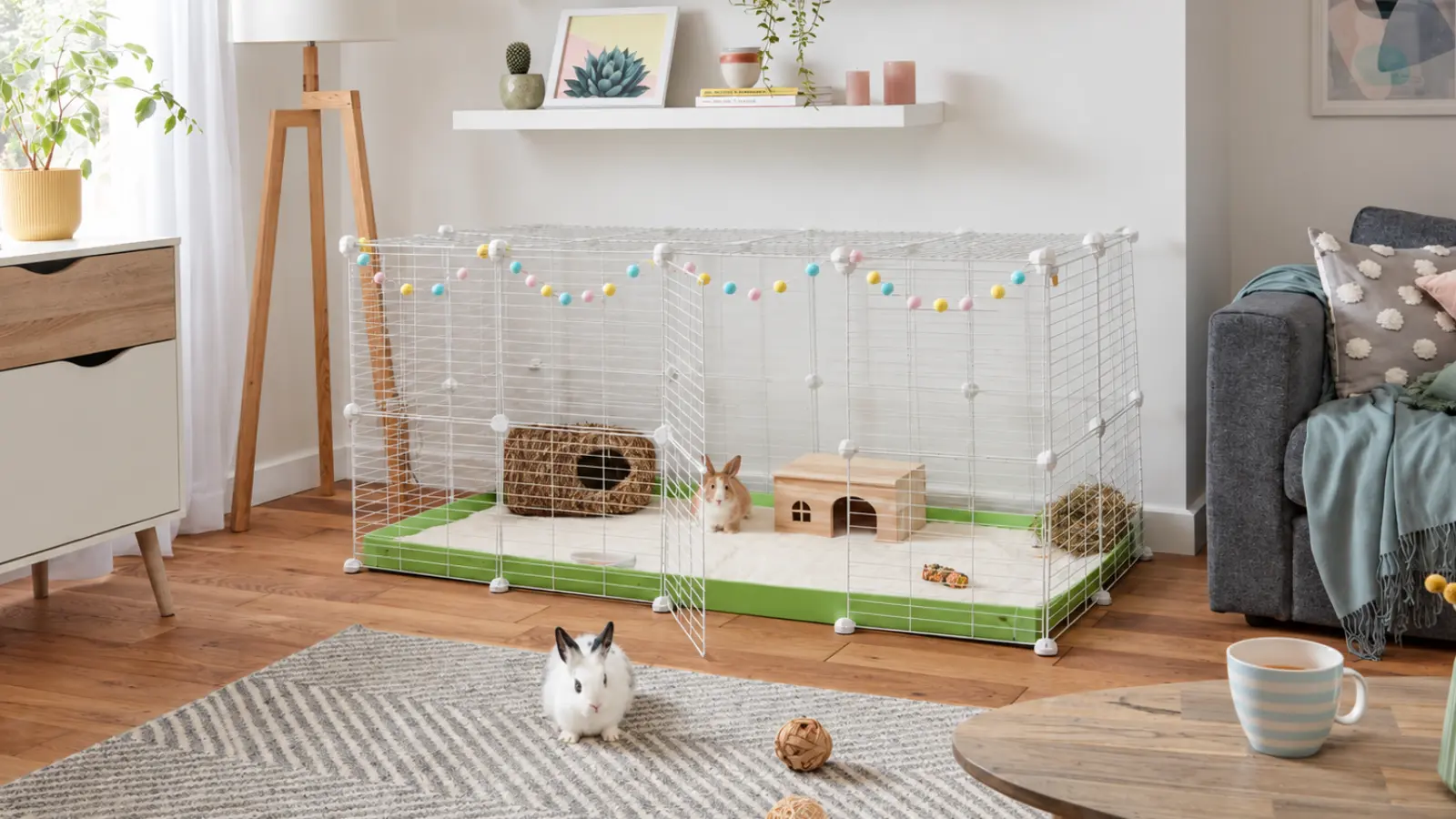
A rabbit’s home should be a pen or a rabbit-safe room, with any cage serving as a bedroom. Rabbit.org describes pens as the preferred modern housing option and says a cage should be three to four times the rabbit’s stretched-out body length just to provide comfortable resting space. Measure your own rabbit, because a dwarf breed and a giant breed need very different amounts of room.
Exercise is part of the housing plan, not an extra. Rabbit.org recommends the opportunity to exercise for at least four hours a day, or 30 hours a week, in a space large enough to run. The simplest setup is a pen attached to the resting area with the door left open, so the rabbit chooses when to retreat.
A few details matter more than size alone:
- Footing: Rabbit.org warns that wire or metal bottoms can hurt a rabbit’s feet and cause sore hocks. On slick tile or hardwood, add washable rugs or mats so your rabbit can grip the floor.
- Location: Rabbits do better indoors in a climate-controlled, well-ventilated area, according to the MSD Veterinary Manual. Place the setup in a cool room away from direct sun and heating vents, near enough to household activity that your rabbit is not isolated.
- Hiding space: Give your rabbit at least one covered spot to retreat to. A prey animal that cannot hide stays on alert.
The full setup, including pen layouts and floor protection, belongs in Rabbit Housing.
Rabbit-Proofing and Heat Safety
Rabbit-proofing is a repeating task, because rabbits chew and explore constantly. Chewing wires is dangerous for both the rabbit and your home, according to the MSD Veterinary Manual, so keep cords out of reach or enclosed, and supervise any time your rabbit spends outside a rabbit-proofed area. Protect baseboards and furniture legs, block gaps where a rabbit could get stuck, and remove houseplants and small objects you cannot confirm are safe. Offer hay and safe chew items so chewing has an acceptable outlet, and change the environment rather than punishing normal rabbit behavior.
Dogs and cats can frighten a rabbit even when they mean no harm, and Rabbit.org lists reducing stress among the ways to keep a rabbit’s digestion moving normally. Supervise any contact and make sure your rabbit always has a place to retreat.
Heat deserves its own planning. The MSD Veterinary Manual notes that rabbits are sensitive to heat and poor ventilation, that long exposure to temperatures above 80°F (27°C) can make them sick, and that hot, humid conditions can cause heat stress or death, especially in enclosed spaces and vehicles. Never leave a rabbit in a parked car or outdoors in hot weather. Provide shade, airflow, and frozen water bottles in summer, as Rabbit.org suggests. If your rabbit shows rapid breathing, drooling, lethargy, or collapse, move it to a cool area and call a veterinarian immediately.
Diet: Hay First, Then Greens, Then a Few Pellets
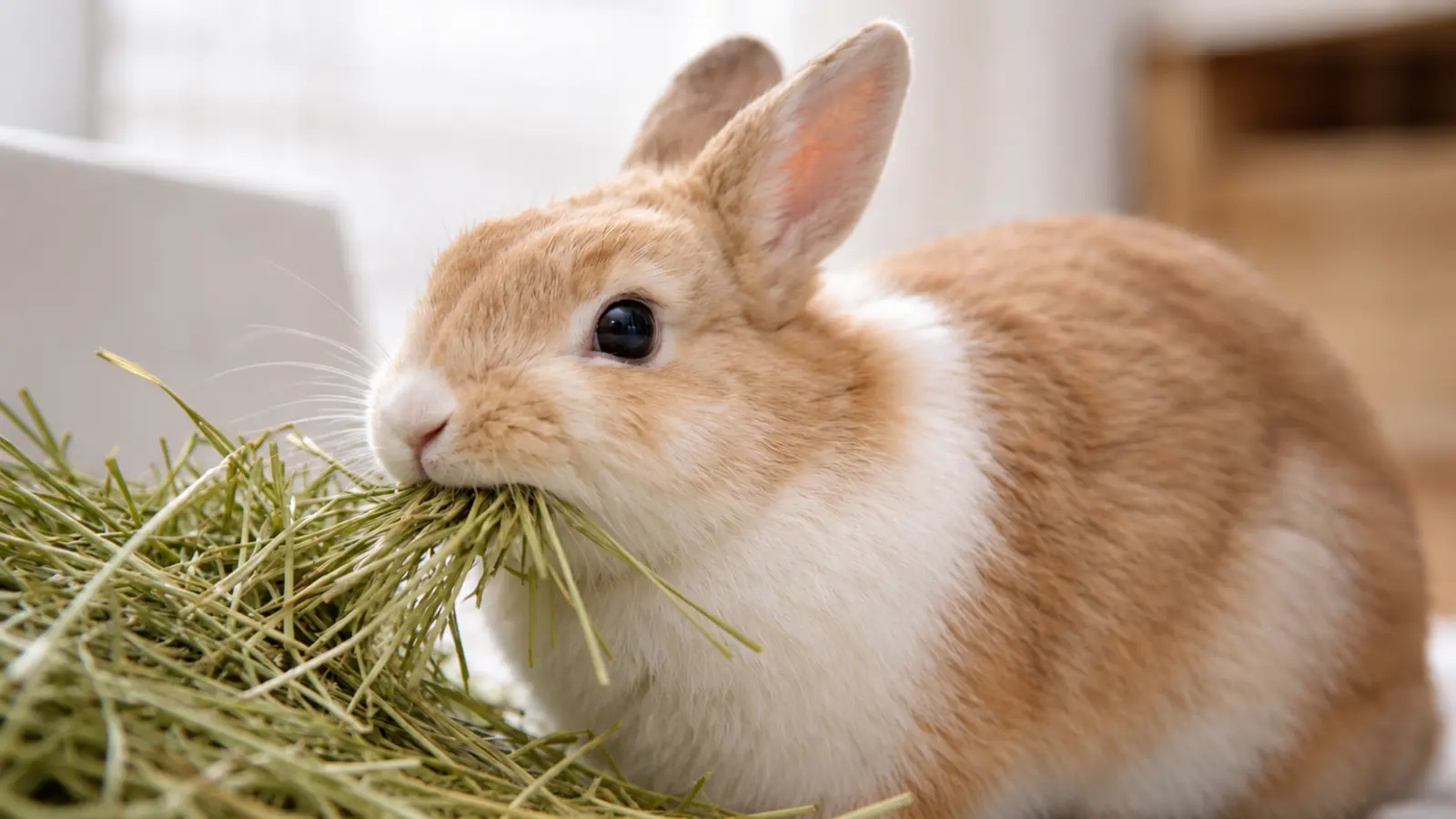
Grass hay is the foundation of a rabbit’s diet. Rabbit.org says hay should make up about 85% of an adult rabbit’s diet and should be offered in large, unlimited amounts every day. Hay provides the fiber that keeps the gut moving and helps wear down teeth that never stop growing.
| Food | Approximate Share | What to Know |
|---|---|---|
| Grass hay | About 85% | Unlimited and fresh daily. Timothy and other grass hays suit adults. Alfalfa is for babies, nursing mothers, and elderly or injured rabbits only, because it is too rich for healthy adults. |
| Leafy greens | About 10% | Rabbit.org’s rule of thumb is 1 to 2 cups of vegetables per 4 pounds of body weight, with at least three types of leafy greens a day. Add one new green at a time and stop it if stools turn soft. |
| Pellets | About 5% | Plain, fresh, timothy-based pellets with at least 18% fiber. Skip colorful mixes with seeds, nuts, or grains. |
| Fruit and treats | Under 5% | Fruit and carrots count as treats because of their sugar. Rabbit.org suggests very small amounts once or twice a week. |
Treat those shares as a starting framework, not a prescription. Pellet amounts in particular vary between rabbit organizations and with a rabbit’s size, age, and weight, so ask your veterinarian for a starting amount instead of relying on a single cup measure. Young, nursing, overweight, older, or ill rabbits can need different proportions, and any diet change should be gradual.
Fresh water should be available at all times, and you should confirm that your rabbit actually uses the bowl or bottle you chose. Keep processed human foods such as bread, cereal, crackers, and yogurt drops out of the diet entirely, since Rabbit.org warns they are especially dangerous for a rabbit’s delicate digestive system. Rabbit Diet covers greens, pellets, and transitions in more detail.
A Daily Routine That Catches Problems Early
A good routine has two jobs: meeting your rabbit’s needs and making change easy to notice. Because rabbits hide illness, the observation step is as important as feeding. The person refilling hay and water should also notice whether the rabbit is actually eating and drinking.
| When | Task | What You Are Checking |
|---|---|---|
| Every morning and evening | Refresh hay and water, offer greens and measured pellets | Is the rabbit eating hay and drinking normally, and does it come to the food with usual interest? |
| Daily | Remove soiled litter and wet hay, and spot-clean the living area | Droppings: size, shape, amount. A clean bottom, bright eyes, and a dry nose and chin |
| Daily, 4 hours or more in total | Exercise time in a rabbit-proofed area | Does the rabbit run, hop, and explore, or sit hunched and unwilling to move? |
| Daily | Calm company on the rabbit’s terms | Does the rabbit approach and relax, or hide and stay tense? |
| Weekly | Full clean of the living area with hot, soapy water, and brushing as needed | Matting, skin changes, or heavy shedding. The MSD Veterinary Manual suggests brushing short-haired rabbits at least twice a week and long-haired rabbits daily. |
A short note or photo of anything unusual makes a vet call far more useful. In a shared home, name one primary person and one backup so the routine never depends on someone remembering. Pet Care Schedule can turn this table into a household checklist.
Litter Habits, Exercise, and Enrichment
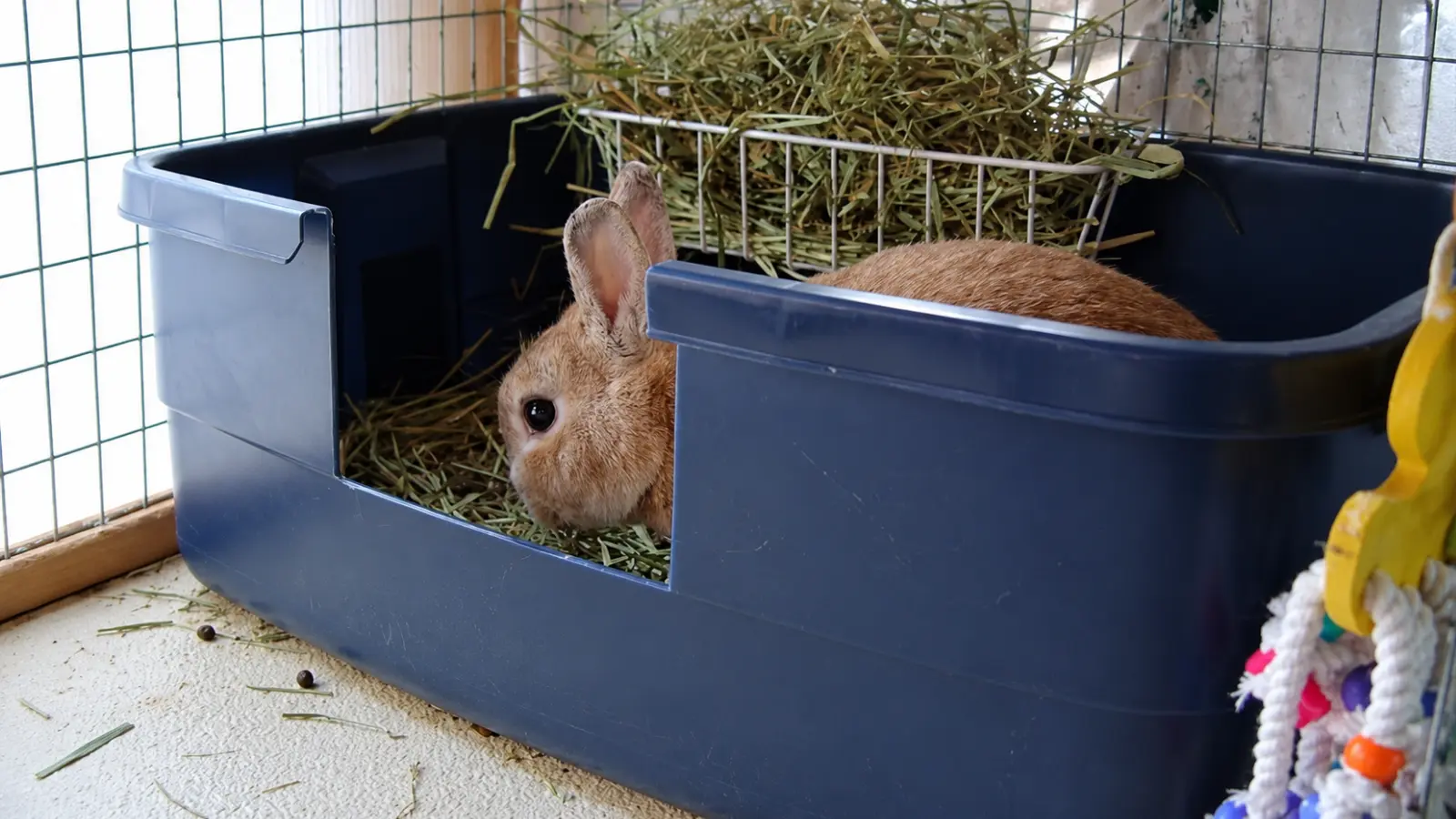
Most rabbits can learn to use a litter box, because they instinctively choose a corner for urine and most of their droppings. Rabbit.org suggests placing the box where your rabbit already goes, choosing one large enough to turn around and stretch out in, and putting fresh hay at one end or just outside it, since rabbits like to eat while they use it.
Litter choice matters for safety. Rabbit.org advises against clay or clumping cat litter, which can cause intestinal blockages if eaten, and against pine or cedar shavings, whose aromatic oils can irritate the respiratory system and liver. Paper-based pellets or shredded paper are a recommended option. For the same reason, a rabbit should not share a litter box with a cat.
Perfect habits are not realistic: a stray dropping here and there is normal. Spaying or neutering makes good litter habits more likely, according to Rabbit.org. If a reliably trained rabbit suddenly changes habits, stress or a new pet can be the cause, but Rabbit.org also notes that a urinary tract infection or another medical problem is possible, so call your vet if the change continues.
Enrichment should fit rabbit instincts. Rabbit.org suggests rotating toys and play areas, and rabbit groups often recommend scattering hay piles in several spots, stuffing small cardboard boxes with hay, and adding tunnels and safe chew items. Keep novelty calm: a rabbit does not need loud toys or constant handling to have an interesting day.
Companionship and Careful Introductions
Rabbits are social animals, and welfare groups generally advise that they live with another rabbit instead of alone. The catch is that rabbits cannot simply be placed together. The MSD Veterinary Manual notes that adult rabbits can fight severely, and a rushed introduction can end in injury.
The RSPCA generally recommends bonding a neutered male with a spayed female, introduced in a neutral area that neither rabbit has claimed, and notes that neutering both rabbits first makes bonding easier. If you have only one rabbit, spend time with it every day, and consider asking a rescue or a rabbit veterinarian about a compatible companion. Even a bonded pair still needs enough space, litter boxes, hiding places, and food for two animals. Rabbit Bonding covers the process in detail.
Grooming, Teeth, and Safe Handling
Rabbits keep themselves clean, so routine bathing is not part of normal care. A persistently dirty bottom is a reason to call your veterinarian, not to bathe your rabbit: Rabbit.org lists diarrhea or a dirty bottom among the signs that need prompt veterinary attention, and flies can lay eggs on soiled fur in warm weather. Brush as the MSD Veterinary Manual suggests, expect a heavy shed every few months, and ask your vet to show you safe nail trimming.
Rabbit teeth grow continuously. Unlimited grass hay and safe chew items support even wear, but they do not replace veterinary care when something goes wrong. Rabbit.org lists lack of appetite, dropping food, a wet chin, smaller droppings, and weight loss as signs of dental trouble, and notes that a veterinarian can trim or file teeth safely under anesthesia.
Handle a rabbit only when necessary. The MSD Veterinary Manual says to support the hind end and back legs whenever you lift a rabbit, never to pick one up by the ears, and warns that a rabbit’s strong back legs can kick hard enough to injure its own spine. Children are safest sitting on the floor with an adult nearby while the rabbit comes to them. Wash your hands after handling your rabbit, its litter, or its supplies.
Veterinary Care, Spay/Neuter, and Vaccination
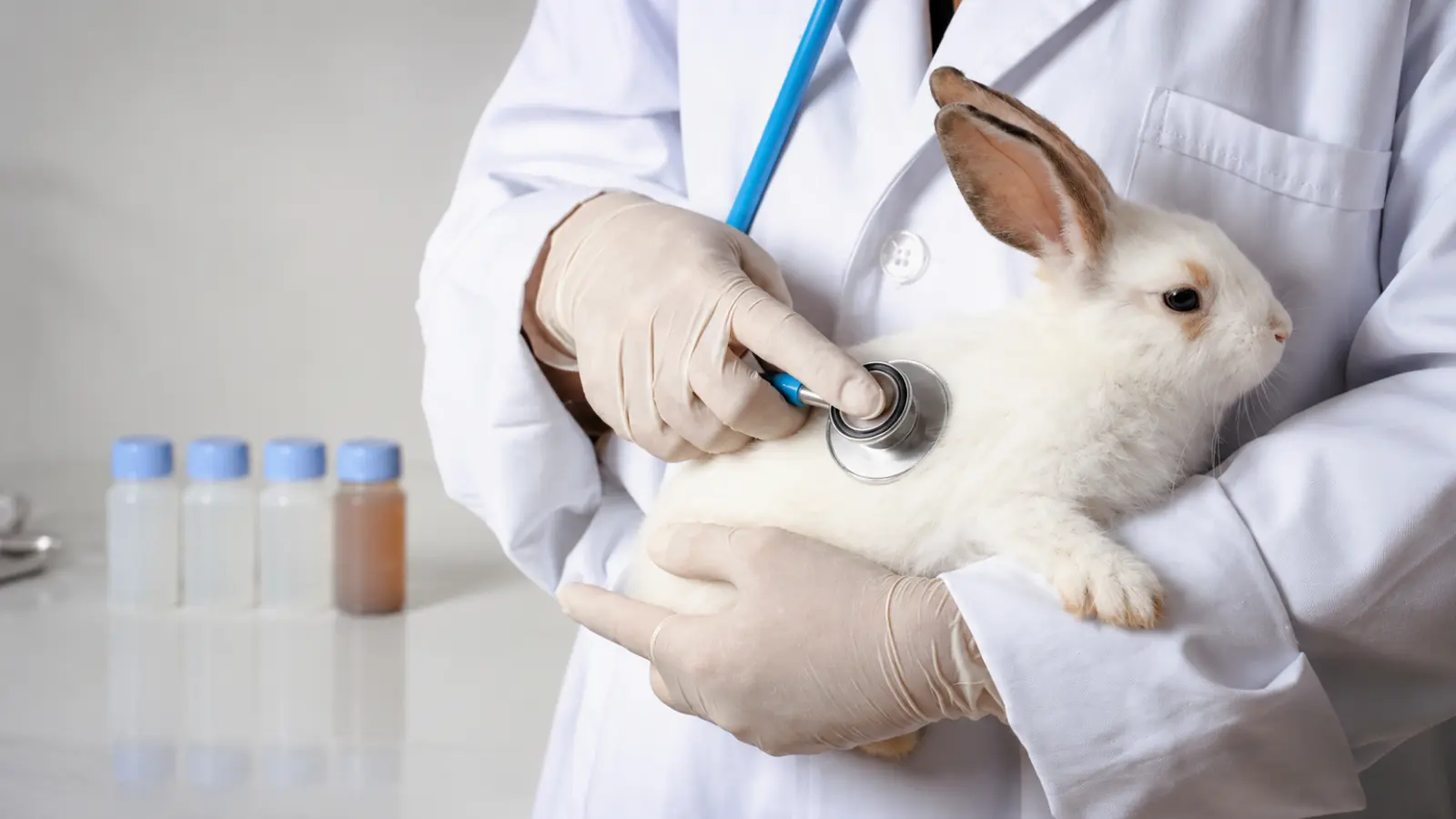
Find a veterinarian who regularly treats rabbits before you need one, and ask which clinic can see rabbits after hours. Rabbit.org recommends annual checkups to catch dental and internal problems early. Keep the clinic’s number and the nearest emergency clinic that accepts rabbits where everyone in the household can find them. The Rabbit.org vet directory is a good place to start.
Two topics are worth raising at the first visit:
- Spaying and neutering: The House Rabbit Society of Chicago notes that the rate of uterine cancer in unspayed females can approach 80% in some rabbit populations, and that altering also reduces aggression and mounting behavior. It should be done by a veterinarian with rabbit surgery experience, and your vet will advise on timing.
- RHDV2 vaccination: Rabbit hemorrhagic disease virus type 2 is highly infectious and often fatal. The AVMA notes that it spreads through direct contact and indirectly on food, water, hands, shoes, and rodents, so indoor rabbits can still be exposed. USDA APHIS has issued a conditional license for a domestically produced RHDV2 vaccine, and Rabbit.org advises yearly protection in the United States. Availability and local risk vary, so ask your veterinarian whether and when to vaccinate.
Rabbit Veterinarian and Rabbit Health will go deeper on choosing a clinic and understanding common conditions.
Warning Signs: When to Call a Rabbit Vet Right Away
The litter box is your best early-warning system. Learn what normal droppings look like for your rabbit, so you can spot a change quickly.
| What You Notice | What It Can Mean | What to Do |
|---|---|---|
| Round, firm, fairly uniform droppings | Normal for a healthy rabbit that is eating enough hay | Keep hay unlimited and learn your rabbit’s usual amount |
| Smaller, misshapen, or noticeably fewer droppings | Can be an early sign that the gut is slowing or that the rabbit is eating less | Check hay intake and appetite now. If it continues or appetite drops, call a rabbit vet the same day |
| Stops eating, refuses favorite foods, or produces no droppings | A possible serious gut problem, one of the most common rabbit emergencies | Call a rabbit vet or emergency clinic immediately. Do not wait overnight |
| Soft, dark, clustered pellets that look like a blackberry | Cecotropes, a normal nutrient-rich dropping that rabbits usually eat straight from the source, so you rarely see them | An occasional leftover is common. Frequent leftovers are worth mentioning to your vet |
| Watery stool or a dirty bottom | Digestive upset, and a dirty bottom raises the risk of flystrike in warm weather | Call a rabbit vet promptly |
Call a rabbit veterinarian or emergency clinic right away if your rabbit suddenly stops eating, refuses its usual food or favorite treats, or stops producing droppings. Do not wait eight hours before seeking help, as gastrointestinal problems can become life-threatening quickly. Other urgent warning signs include sitting hunched, grinding teeth in pain, hiding unusually, difficulty breathing, diarrhea, a persistently dirty bottom, loss of balance, head tilt, difficulty using the legs, or heat-stress symptoms such as rapid breathing, drooling, lethargy, or collapse. Visible maggots or a foul smell around the rear are also emergencies. Do not attempt home remedies, force-feeding, or leftover medications unless a rabbit-experienced veterinarian specifically instructs you to.
This article provides general pet-care information and is not a substitute for veterinary diagnosis or treatment. When you call, say when the change started, what the droppings look like, and whether you changed food or surroundings recently.
Where to Go Next
This guide is the rabbit-care starting point, not the whole library. Continue with the guide that matches your next question:
- Rabbit Housing: pen layouts, flooring, and room setup
- Rabbit Diet: greens, pellets, treats, and transitions
- Rabbit Bonding: introductions and pairing
- Rabbit Grooming: coat, nails, and shedding
- Rabbit Health: common conditions and prevention
- Pet Safety at Home: everyday hazards to fix before arrival
A rabbit that has room to run, endless hay, a clean litter box, and an owner who notices small changes has a strong chance at a long, healthy life.
Give Your Rabbit the Space, Care, and Attention It Needs
Caring for a pet rabbit means providing more than food and shelter. A spacious, secure environment, unlimited grass hay, fresh water, regular exercise, appropriate companionship, and attentive daily care all contribute to a rabbit’s well-being. Understanding natural behaviors and respecting your rabbit’s boundaries can also help build trust and make everyday interactions more comfortable.
As your rabbit grows and its needs change, continue reviewing its diet, living space, behavior, and health with guidance from a rabbit-experienced veterinarian. Pay attention to changes in eating, droppings, and activity, and seek veterinary help promptly when something seems wrong. Consistent care and early attention to potential problems are essential parts of giving your rabbit a safe and fulfilling life.
Frequently Asked Questions
Are pet rabbits easy to take care of?
Rabbits can be wonderful companions, but they are not low-maintenance pets. They need spacious housing, unlimited grass hay, daily exercise, regular cleaning, social interaction, and veterinary care from someone experienced with rabbits. They also require careful health monitoring because they often hide signs of illness. Many well-cared-for rabbits live 8 to 12 years, making ownership a long-term commitment.
What should you feed a pet rabbit every day?
A healthy adult rabbit should have unlimited fresh grass hay, clean water, appropriate leafy greens, and a measured amount of high-fiber rabbit pellets. Timothy, orchard grass, and other suitable grass hays support digestion and healthy tooth wear. Carrots and fruit should be occasional treats rather than daily staples. Introduce dietary changes gradually and consult a rabbit veterinarian about portions and individual nutritional needs.
Can a pet rabbit live in a cage?
A small cage is not suitable as a rabbit’s primary living space. Rabbits need a spacious indoor pen or rabbit-proofed room where they can hop, stretch, stand upright, and move naturally. Provide comfortable flooring, a hiding place, a litter box, and safe enrichment. Rabbits also need several hours of daily exercise, ideally with access to enough space to move freely throughout much of the day.
Do pet rabbits need another rabbit for companionship?
Rabbits are social animals that generally benefit from living with a compatible, bonded rabbit companion. A properly introduced, spayed-and-neutered pair is often a good arrangement, but unfamiliar rabbits should never be placed together without a careful bonding process. Introductions can lead to serious fighting if rushed. Human interaction remains important, but it does not fully replace the social behaviors rabbits share with their own species.
Can pet rabbits be litter trained?
Yes. Most rabbits naturally prefer particular areas for toileting, making litter training possible with patience and consistency. Place a spacious litter box where your rabbit already urinates, use rabbit-safe paper-based litter, and provide hay nearby. Avoid clumping cat litter and aromatic wood shavings. Spaying or neutering often improves litter habits, while sudden changes in a previously trained rabbit may warrant veterinary attention.
What should you do if your rabbit stops eating or pooping?
Contact a rabbit-experienced veterinarian immediately if your rabbit stops eating or producing droppings, rather than waiting for a specific number of hours. Reduced appetite, unusually small droppings, a hunched posture, or signs of pain can indicate a serious digestive problem, including gastrointestinal stasis. Do not attempt force-feeding, give leftover medications, or rely on home remedies without veterinary instructions. Delaying treatment can become life-threatening.